Lunar Eclipse – March 3, 2026

The March 3 total lunar eclipse has been generating some buzz. Unfortunately the only totality I experienced was totally missing it. By 6am the moon had set in my location – at 05:57 per Sky Safari to be exact. I could have gotten up an hour earlier to catch a partially eclipsed view but, as previously established by Nova Sagitarii, I can be a bit of a “slug-a-bed”.

Those further west had more convenient viewing opportunities and I’ve seen some good reports and images of the eclipse. Michael E. Bakitch has an excellent observing report over at Astronomy.

I can recall observing two total lunar eclipses in their entirety. The most recent one was in September of 2015, during which I was able to watch the entire event and photograph a sequence from the penumbral eclipse to totality. Prior to that, it had been nearly twelve years since my first complete lunar eclipse viewing in November, 2003. The photographs from that eclipse can be seen in this post on the Easter weekend 2015 eclipse.

According to the eclipse list at Time and Date, the next potential total lunar eclipse visible in North America looks to be in June 2029. Three years isn’t so long. It’s just a few times around the Sun.

-Dave

Original content copyright 2026 by David Philips. All Rights Reserved. This post may contain links to affiliate sites; sales through affiliate links may benefit this site.

Pointing the Way – A Guide to Telescope Finders

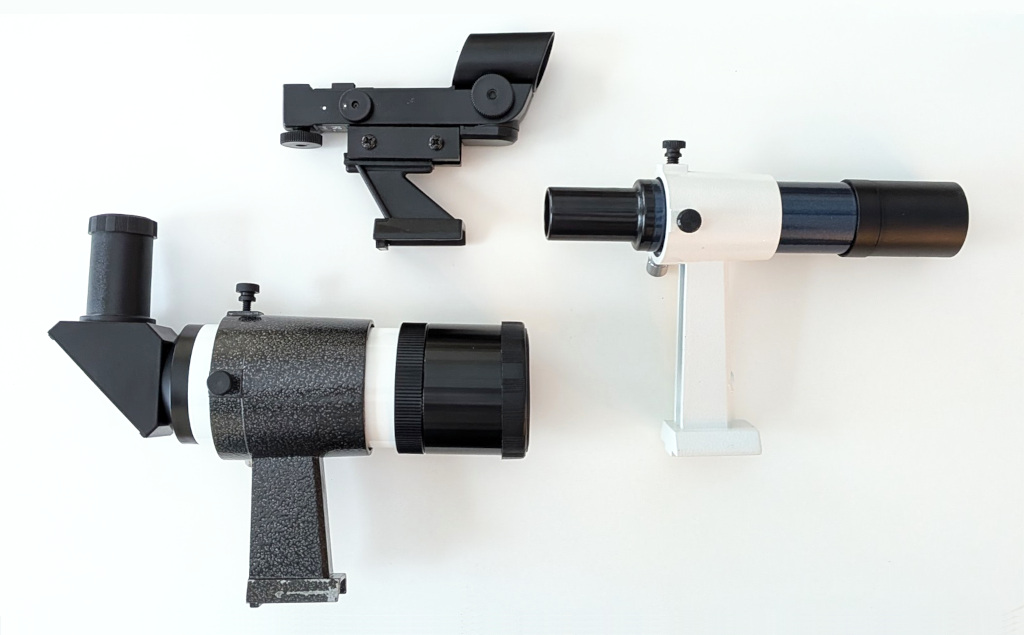
Several different telescope finders and finderscopes

Telescope finders and finderscopes (clockwise, from top): Red dot finder, 6×30 straight-through, 8×50 RACI

In the excitement of selecting a first telescope many beginners overlook the importance of the finder. While finders and finderscopes may not be the most exciting pieces of observing kit they play an essential part in any telescope setup. The night sky holds countless visual treasures but in order to enjoy the enhanced views of these wonders offered by your telescope you’ll need to be able to point it accurately.

Without a good finder the task of getting a desired object within the view of the eyepiece can become a time-consuming and frustrating experience. Most telescopes show only a sliver of the sky at any given time, and even bright objects can prove surprisingly elusive. A finder serves as a bridge between the vast canopy of the night sky and the magnified but confined field of the telescope.

Read more…

T.O.A. Turns Eleven

My, how time flies! The first post on The Opportune Astronomer went live on February 18th, 2015 – eleven years ago!

It’s also hard to believe that my last post was nearly nine years ago. In some respects, the astronomy landscape has changed dramatically in the intervening time: Orion Telescopes has closed its doors and Svbony has risen as a ubiquitous supplier, steadily improving in both quality and reputation.

Electronic-assisted observing has matured significantly. What just a few years ago required a laptop and an array of electronics is now becoming more integrated and accessible through a new generation of “smart telescopes” from DwarfLab, SeeStar, and Unistellar.

Read more…

Waxing Gibbous

Waxing Gibbous moon projected onto focuser dustcap of a 10″ Dob.

Around here, when the skies are cool and clear and the mood strikes to get out under the stars with a telescope the call is answered, and sometimes that means ignoring the bright Moon that is lighting up the entire yard and making Magnitude 4 stars a challenge to spot.

Tonight was one of those nights and after viewing my intended subject I turned the telescope to the Moon despite only bringing out a single low power eyepiece. Even at 33x the view was rich with detail, my favorite being a crisp view of the Alpine Valley.

Removing the eypeiece to pack up I was struck by the brightness of the unfocused moonlight streaming from the open focuser and then by the fuzzy image of the moon appearing on the dustcap as it was inserted.

I’m sure I’m not the first to stumble across this epiphany of just how bright the moon is but, seeing it projected onto the dustcap and then focusing it, I was surprised at the clarity of the image on the plastic cap. It was even bright enough for me to turn on the back yard lights and snap a picture with the telescope partially lit.

How fascinating is this lesser light in our sky!

-Dave

Original content copyright 2017 by David Philips. All Rights Reserved. This post may contain links to affiliate sites; sales through affiliate links may benefit this site.

Summer-weight Observing with Binoculars and Sky Safari

Summer has traditionally seen a waning in my telescope use. Longer days that see twilight stretching into night time hours put a bit of a damper on my enthusiasm to spend a lot of time viewing and then there are the bugs. Dare to stay out too long without mosquito protection and you’ll quickly regret it. While I’ll be sure to bring a telescope on any trip to darker skies, during the summer months my backyard viewing time is generally more limited and oriented around binocular observing.

Read more…

Mercury Transit

Today Mercury crossed between the Earth and the Sun. These Mercurial transits occur roughly 13-14 times a century – the last one was in 2006 and though we only have to wait until November 2019 to see the next one, the following transit won’t happen until 2032.

Between clouds and trees in my Eastern sky this morning I wasn’t sure I would be able to catch the beginning of the transit but it worked out. I set up my 80mm refractor with a Baader solar film filter for white light viewing. With this telescope an 8-24mm zoom eyepiece gives me 20-60x, which is just about right for solar viewing as the high end of the range still allows the entire disk to fit within the field of view and daytime seeing conditions don’t often allow very high powers.

Read more…

Gary Seronik leaving Sky & Telescope

Sky & Telescope’s May 2016 issue announces the departure of Gary Seronik who will be leaving the magazine become the chief editor of the Canadian SkyNews. Over the past 20 years Gary has made significant contributions to S&T and the May issue contains his final columns.

One of my favorite regular features of S&T has been Gary’s Binocular Highlight column. In fact it was with a planisphere and a copy of Binocular Highlights, a collection of articles from the column published in book form, that I first started observing and I’d highly recommended the same combination to other would-be enthusiasts.

I’m glad that the monthly Binocular Highlight will continue to appear – starting with the June issue it is to be taken over by Matt Wedel of 10 Minute Astronomy. Here’s wishing both Gary and Matt the best in their new roles.

-Dave

Original content copyright 2016 by David Philips. All Rights Reserved. This post may contain links to affiliate sites; sales through affiliate links may benefit this site.

Vanguard Auctus Plus 323AT Tripod Sale

Vanguard 323AT Tripod

B&H Photo is having a sale on the Vanguard Auctus Plus 323AT tripod.

This sturdy, ~8lb tripod will make a good platform for the AWB OneSky and can even be used with a 4″ refractor, provided it isn’t too heavy or long.

After receiving mine and being impressed with the stoutness and quality I thought I’d pass this along. If you’re looking for a stable, mid-weight tripod for photography* or spotting / telescope use this is an amazing deal at the sale price of $159.99.

*Though it’s a bit on the heavy side unless you use a larger format and lenses.

[Update As of Mar. 3rd, 2016 it looks like B&H has sold out and the tripod now shows as discontinued.]

-Dave

Original content copyright 2016 by David Philips. All Rights Reserved. This post may contain links to affiliate sites; sales through affiliate links may benefit this site.

Levenhuk Strike 900 Pro Refractor Review

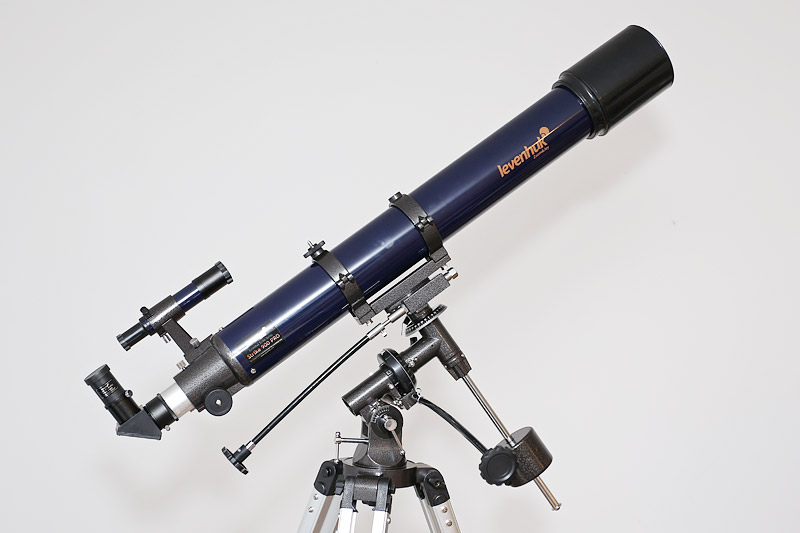
Levenhuk Strike 900 Pro

The Levenhuk Strike 900 Pro refractor and EQ2 mount.

The burgeoning astronomy enthusiast faces one of the most difficult decisions in the hobby – what to choose for a first telescope? The choice is difficult not only because of the vast range of available options but more so because of a lack of awareness of the viewer’s own preferences and tendencies. Ideally the first instrument will nourish a love of viewing the night sky that will enable the observer to get over any inconveniences or difficulties that might be encountered early in their journey.

I tried to keep these considerations in mind when assembling my impressions of the Levenhuk Strike 900 Pro – an equatorial mounted, long focus refractor kit clearly designed with beginners in mind. Before we start I do want to point out that this telescope was provided by Levenhuk on loan for the purposes of this review and I have spent the past four weeks putting it through its paces.

Read more…

Supermoon Lunar Eclipse

Total lunar eclipse on September 27, 2015.

Total lunar eclipse sequence on September 27, 2015. Photos by David Philips.

We had clear skies for Sunday night’s lunar eclipse and it was quite a show. I was able to photograph a sequence from umbra to totality lasting about 2 hours.

The photos were taken from my back yard with a digital SLR attached to a 5″ refractor at prime focus. Exposures ranged from 1/250 second at ISO 100 to 1/3 second at ISO 6400. With the exception of the last image, the bottom half of the sequence are blended exposures.

-Dave

Original content copyright 2015 by David Philips. All Rights Reserved. This post may contain links to affiliate sites; sales through affiliate links may benefit this site.